From changing storage metrics to potential data access limitations, here’s how the new platform may affect analytics.
By Joel Meirovitz, Director of Digital Marketing
Establishing a reliable and efficient process for interpreting data about your ads, content and audience engagement is essential for refining your brand message while increasing growth over time. When platforms and tools make changes, familiarizing yourself with the ways it may affect your process and learning how to adapt keeps things moving forward.
Recently, Google announced its plan to sunset its most popular analytics platform for the next generation version. The current version of analytics, known as Universal Analytics, was made for a time before mobile devices and apps were popular, when all traffic was happening on a desktop computer using cookies.
With the upcoming deprecation of cookies, Google has decided Universal Analytics is no longer accurate for this modern world and is becoming obsolete. It will be officially discontinued on July 1, 2023. GA4, the fourth iteration of Google Analytics, relies on events instead of cookies, and does not store user information, such as IP addresses, which conforms to new privacy rules across the internet.
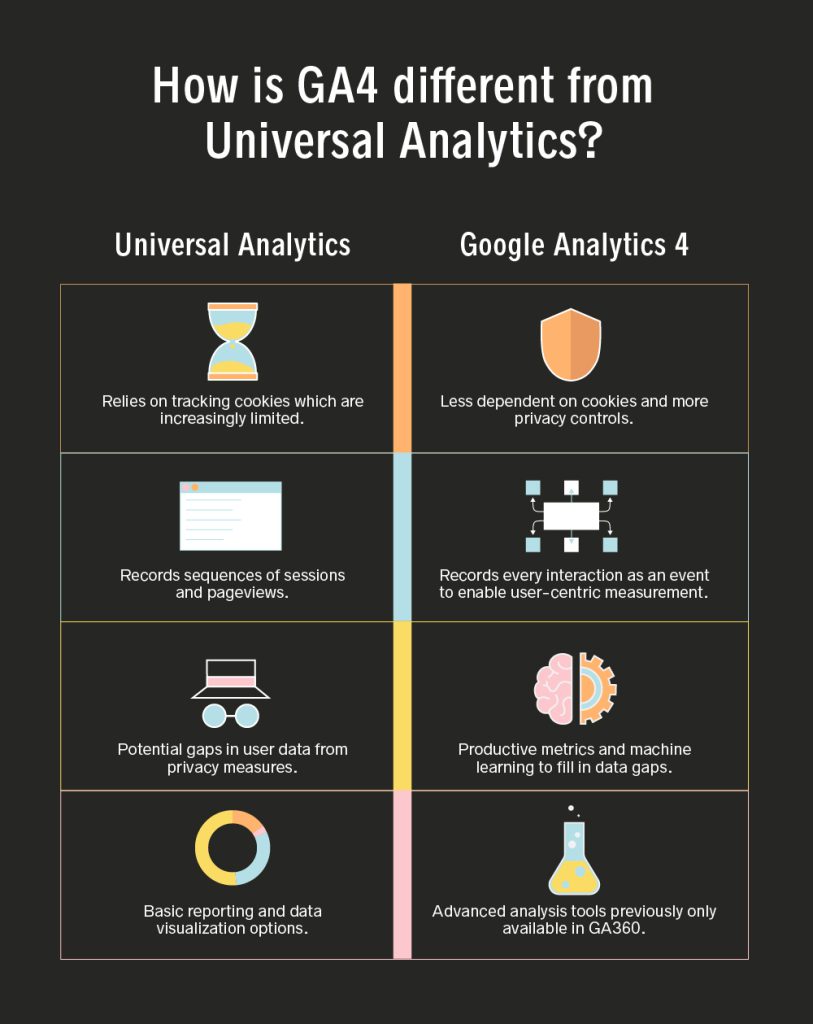
Google had received significant criticism for this, as GA4 is not yet completely stable in its current version. The main concern for most users is that there will be no way for them to import any of their historical data, which means most people are going to lose all the data they’ve been collecting for the past 5, 10, or in some cases 20-plus years.
At Russell Herder, we are prepared for this transition and will be reaching out to clients this month about updating to GA4 now, so that when the transition takes place in July 2023, our clients have at least a year’s worth of data in the new platform. We also remain hopeful that Google will figure out a way to save people’s historical data from their Universal Analytics accounts. As Google’s data process changes, experts at Russell Herder can guide you and your brand through data collection and analysis, helping to shape the results you seek. Contact our team at [email protected].[/vc_column_text][/vc_column][/vc_row]